You want to cut your dog's claws? This guide is designed to help you cut your dog's claws properly and without any major mishaps. We have also obtained advice for this article from veterinarian Mag.med.vet. Emin Jasarevic for this article.

In many older dogs, the claws wear less because they move less. Accordingly, in many cases it is necessary to cut the nails.
Your furry friend's claws sometimes don't wear off enough by themselves. Claws that are too long can cause him pain and lead to health problems:
Initially, the claws hinder walking, and the individual toes of the bale push upwards when stepping. This is quite painful for your faithful friend, especially during long walks.
It tries to counteract this by adopting a relaxed posture, which can lead to postural damage and joint and back problems in the long term.
The claws can grow in, break off and, in the worst case, even tear out. Not only is this extremely painful for your pet, the resulting wound can also become infected. The risk of infection is very high with ingrown and torn claws.
Trimming claws makes walking much more comfortable, minimizing the risk of injury and preventing health problems.
You usually don't even need to look to see if the claws are too long.
**Because:**If your four-legged friend walks over parquet or tiles and a clear click can be heard, the nails are too long.
If you look at the claws, they should be no more than the length of the ball and not touch the ground. This guideline applies to many dogs. It becomes problematic if the cutting is delayed too long.
The longer the claws become, the more the vessels and nerves within the claw expand. In this case, you often have to shorten the claws. However, only piece by piece. Nerve tissue and vessels can recede over time, so the process is reversed by shortening. This guideline applies to many dogs. **
You can use claw nippers to shorten the claws. The blades of these pliers are rounded for optimum cutting. You can also use nail clippers for small dogs. The claw nippers may be too big for them.
It is important that the pliers are not blunt and fit well in the hand. The aim is to prevent the nail from being crushed or bent. The faster and more precise the pliers cut, the more comfortable it is for your furry nose and ultimately for you.
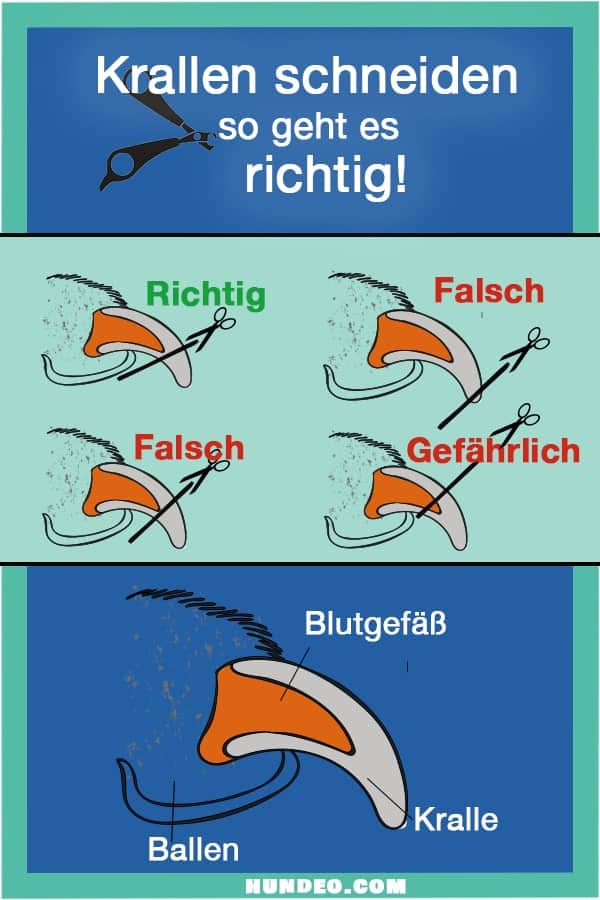
Because of the nerves and vessels, you can not just cut the claws at any point. This will cause your pet pain and bleeding. If he suffers pain, this leads to avoidance behavior. You should therefore know exactly where you can cut.
If necessary, a grinder may be the tool of choice for you. In all cases, it is important that you apply sensitivity and only shorten the claw piece by piece. Sufficient light should also be available.
A flashlight is recommended for light-colored claws. You can shine a light through the claw and easily see the nerve tissue and blood vessels.
The claw is to be shortened by one millimeter per cut. Stop a maximum of two millimeters before the vessels. Shortly before you will already notice a change in the nail tissue. This becomes more and more pink.
You cannot shine a flashlight through dark claws. You must therefore orientate yourself by the nail tissue or the cut surface. If you see a dark spot, you are close to the blood vessels.
It is best to work gradually millimeter by millimeter, so you avoid cutting into the areas with blood flow. Some breeds have inherently very long claws with blood vessels running through them.
If a mishap does occur and your darling bleeds, this is quickly stanched with some high-proof alcohol.
It can be awkward to clip your dog's nails while standing. You would have to lift his paw first. However, as your pet cannot move his legs to the side, it would be difficult to see his paws. It would be difficult to assess where the vessels begin.
Cutting the paws from behind is also more complicated. This is because standing on three legs is extremely complicated for a dog. The danger is that he could lose his balance. Then your pet would probably pull his paw away jerkily and could injure himself.
Remember: Trimming is easier if your furry friend is lying on its side. Each paw is easy to reach, see and trim.
For some dogs, clipping their claws is very stressful and they may react in a panicky manner.
In this case, you can try to gradually get your furry companion used to the clippers. Perhaps start by getting him used to the clipper and only touching his paws with it.
To save him stress, you can trim one claw per day. In any case, you should remain calm when he pulls his paw away or wants to run away. If you become impatient, this impatience will be transferred to him. Your pet will probably become even more panicky.
In some cases, it may be more comfortable for both sides to use a file.
Puppies' claws can be really sharp. But should you start when they are puppies? Generally speaking, you don't have to do it at puppy age. It's better to make sure your puppy is well trained and that it wears down its claws while playing.
Getting puppies used to having their paws touched is of crucial importance. If the puppy's nails are already trimmed and he does not experience any pain or impatience, he will generally not develop a negative attitude towards nail trimming as an adult.
When to trim the claws in puppies? This always depends on the wear of the claws. Once a week to check his paws, but makes sense.
If you are still unsure, you can first be shown the correct technique by a veterinarian or in a dog salon. Of course, this raises the question of how much it costs to cut the claws in a dog salon or at the vet. The costs are different and move in a dog salon usually between 10 € and 15 €. At the vet, dog claws are shortened from about 15 € upwards - depending on the veterinary practice, this can also be included as a service with a major examination of the dog.
Lay the darling on its side and provide sufficient light so that you have an optimal view of the paws and claws.
In any case, try to radiate calmness, as this will be transmitted to your four-legged friend. If you notice that you are unbalanced today or he is nervous, you should perhaps rather cut the nails on another day.
If you use claw nippers, please check if they are sharp enough.
For white claws you can use a flashlight to see where the blood vessels begin. You can remove the pure white portion up to two millimeters in front of the vessels.
For black claws you work your way forward successively until you discover a black dot in the center of the claw. This is a sign that blood vessels will soon appear.
You can remove the gray and keratinized part without any problems. Sound knowledge and practical tips help us all to take the next step in the right direction in an easier way.
I'm sure the tips I've passed on to you will definitely keep you going without losing your cool.
You can already look forward to the moments when your darling just sticks his paws out and lets you spoil him 😊 You will also get your share. The serene calm will also reflect on you.
A real doping for you and your most faithful friend.