
Your dog can't settle down, goes wild on car rides, or wrecks the place when he's left alone? A crate solves all of these problems, but only if your dog gets to know it as his safe place. In 4 steps you'll get him used to it: from the first curious sniff to relaxed time alone in the crate.
- The crate becomes a safe retreat, never a punishment
- Useful for transport, vet visits, time alone and during injuries
- Training in 4 steps: explore the crate, go in with a cue, close the door, stay alone
- The right size: the dog has to be able to stand comfortably, turn around and lie down
- Introduce puppies to the crate early, it saves effort later
- Never force it, never punish, the dog sets the pace
Why a dog crate makes sense

A retreat at home. The crate gives your dog a sheltered spot when the hustle and bustle of the household gets to be too much. Visitors, kids being loud, other pets: the dog can retreat into his crate and find some calm there. Many dogs seek it out on their own once they've finished the training.
Transport and travel. In the car the dog has to be secured. A travel crate in the trunk is the safest option, because it protects the dog during hard braking and secures the cabin at the same time. For air travel, an approved hard-plastic crate is required. When the dog knows his crate and goes in willingly, transport is much more relaxed. In unfamiliar surroundings like a hotel or vacation rental, the familiar crate gives the dog a sense of security, because he has his mobile home with him. On long car rides especially, a dog who knows his travel crate as a resting place is much better off: he lies down and sleeps instead of panting nervously on the back seat.
Vet visits. At the vet, the familiar crate helps. A dog who knows his spot stays calmer in the waiting room. He doesn't have to sit out in the open and deal with strange dogs or noises.
Recovery after injuries. Some injuries or surgeries require the dog to move as little as possible. A crate he feels comfortable in makes the prescribed rest more bearable for both sides. Without prior crate training, the forced rest becomes a source of stress. That's why vets recommend doing the training preventively, before an injury happens. If you only start after surgery, you have to get an injured, stressed dog used to something new, and that rarely works.
Practicing time alone. Dogs who can relax in their crate also cope better with being alone. It provides structure and limits the space the dog stays in. That reduces sensory overload and helps insecure dogs calm down.
Choosing the right dog crate

Size
The crate has to be big enough for the dog to stand comfortably, turn around and lie down stretched out. As a rule of thumb: 10 to 15 cm longer and taller than the dog, at least twice as wide as the dog lying on his belly. A crate that's too small creates stress. A model that's too big doesn't give the dog the sense of security that a snug den provides. For puppies there are crates with a divider that grow with them.
Material
Metal crates (cages). Sturdy, durable, well ventilated. The dog has a view all around, which calms some dogs and makes others nervous. A blanket over the crate creates more of a den feeling. Metal crates fold flat and work both at home and as a mobile solution for traveling.
Hard-plastic crates. More enclosed than metal crates, so the dog feels protected sooner. Easy to clean and hygienic. Required for air travel (follow IATA regulations). A safe choice in the car, because the rigid shell offers protection in a crash.
Fabric crates. Light and quick to set up. Suitable for small dogs and short use. Not sturdy enough for dogs who scratch or gnaw at the crate. Only somewhat suitable as a permanent solution.
Location
The crate needs a fixed spot in your home. Ideally in a quiet corner of the living room, where the dog has family company but isn't constantly disturbed. No direct sunlight, no drafts, no high-traffic area. In everyday life the crate door stays open, so the dog can decide for himself at any time when he wants to go in or come out.
Some owners set up a second crate in the bedroom, especially when the young dog is supposed to sleep nearby at night. That makes the first few weeks much easier. Important: never place the crate right next to the front door. Every doorbell and every visitor brings commotion to the resting spot. Dogs who can't find peace there will use the crate less. The best spot is one where the dog can survey the room without being in the spotlight himself.
Getting your dog used to the crate: training in 4 steps
The goal: the dog goes into the crate willingly, stays relaxed in it and isn't stressed by the door closing. The training builds up step by step. Each step has to be solid before the next one comes. Move too fast and you risk the dog associating the crate with stress.
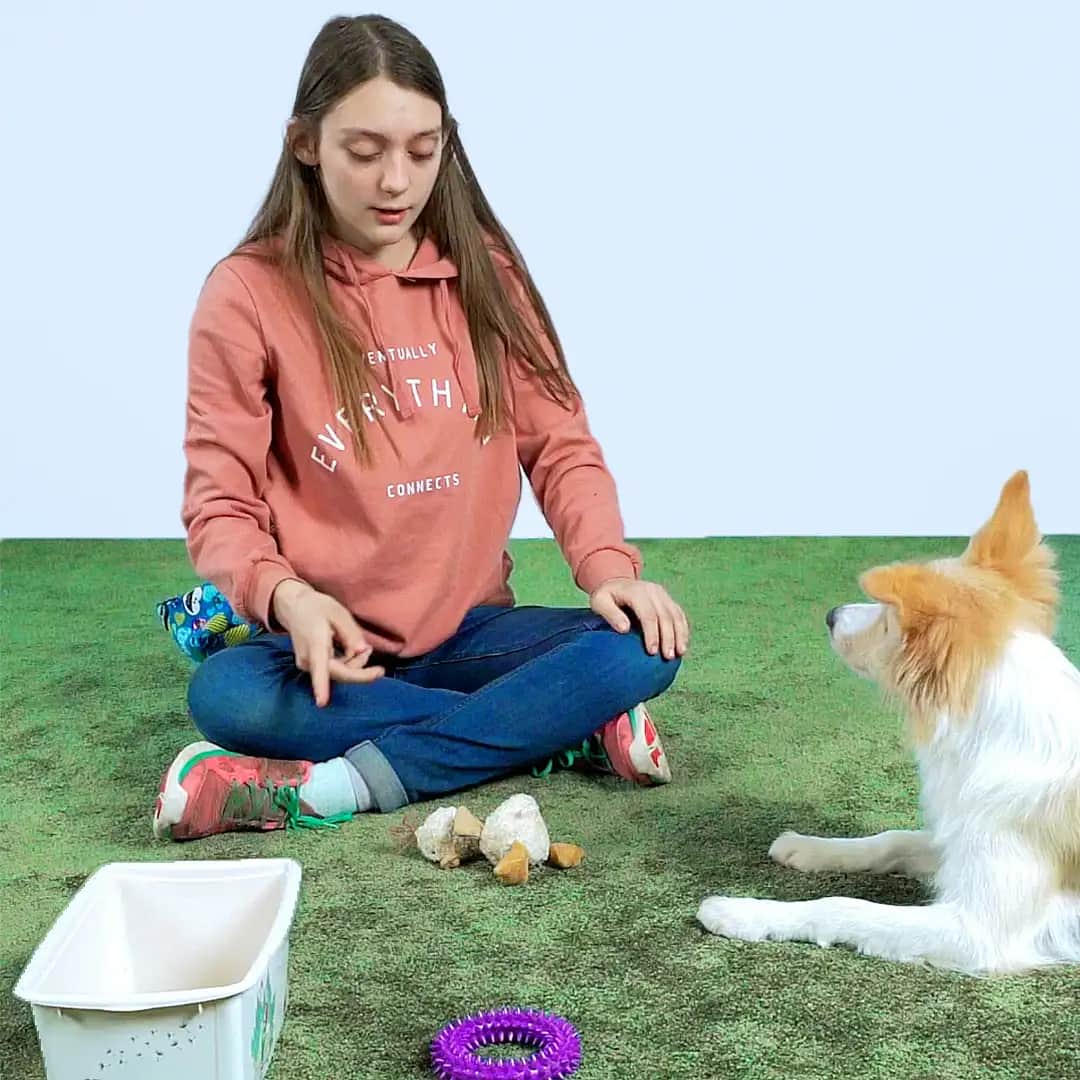
Step 1: Let your dog explore the crate. Put the open crate in the room and leave your dog in peace. Place a few treats in front of the entrance and one inside. Your dog sniffs, sticks his head in, maybe even goes all the way in. No pushing, no shoving, no luring with your hand. Every voluntary step closer is a success. Some dogs need days before they dare to go all the way in. That's normal. During this phase the door stays open at all times. Repeat this over several days until he goes in without hesitation to get his treat.
Step 2: Going into the crate with a cue. Once your dog reliably goes into the crate, you link it to a cue. Say "crate" (or another short word) just before the dog goes in. Then a treat inside. After a few repetitions you test it: give the cue and wait. If the dog goes into the crate on the signal, he's learned the association. Reward every time. Optionally, you can also train a cue for leaving ("out" or "free") by saying it as the dog comes out and rewarding that too.
Step 3: Close the door and build up the duration. Your dog is lying relaxed in the crate. Now you close the door for a few seconds. Open it again right away and praise. The next time, five seconds longer. The time after that, a bit longer again. The dog should learn that the closed door is no problem, because it keeps opening again. Give him a stuffed Kong or a chew so he's busy in the crate. Stay in sight so he doesn't feel alone. Once the dog can lie calmly with the door closed while you're in the same room, he's ready for the next step.
Step 4: Staying alone in the crate. Step out of the room briefly. First 30 seconds, then a minute, then five minutes. Come back, open the door, praise calmly. No big greeting fuss, otherwise the dog learns that your leaving is exciting. Build up the absences slowly. Once your dog can lie in there relaxed for 30 minutes, the core of the training is done. After that it's about adjusting the duration to everyday life. With good training, an adult dog can stay there up to 4 hours. It shouldn't be any longer.
Your training plan
0/6For adult dogs who have never been in one, the whole build-up often takes 3 to 6 weeks. A dog who had bad experiences with being shut in at his previous home needs even longer. Don't push here, instead stay at step 1 until he goes in on his own. Some dogs benefit from eating their meals in the open crate. That builds a positive association without the door ever having to be closed. Only once the dog accepts the crate as his spot do you move on to the next steps.
Getting puppies used to the crate

Puppies learn faster than adult dogs because they don't have any negative experiences with a crate yet. The best time: from the first week in their new home. The crate becomes part of everyday life from the start, not something new the young dog only gets to know later. The effort of getting a young dog used to the crate is much lower than with an adult dog.
Sleeping at night. Many breeders recommend letting the puppy sleep in a crate next to the bed. The young dog feels your closeness and at the same time has his own spot. That keeps him from roaming the home at night, chewing on cables or leaving puddles. After a few weeks you can gradually move the crate away from the bed to its permanent location.
House-training. Dogs avoid soiling their sleeping spot. A young dog who sleeps in an appropriately sized crate usually holds it. If you take him outside right after he wakes up, he quickly learns to do his business outdoors. The crate must not be too big, or he'll use a corner as a toilet.
Rest periods. Young dogs need 18 to 20 hours of sleep a day. But many don't settle down on their own, because every stimulus is more exciting than sleeping. A crate helps him wind down. When he gets tired after playing or eating, you can put him in his crate. The low-stimulus environment helps him fall asleep faster.
Short periods. Young dogs can't hold their bladder for long. Up to 12 weeks, a young dog should stay in there no more than 1 to 2 hours at a time. He can hold out for about one hour per month of age. Longer periods overwhelm the young dog and can destroy his positive feeling toward the crate.
In a puppy class, crates are often used, because the puppies there learn to settle down in the crate even in an exciting environment.
Common mistakes
The crate as punishment. Putting the dog in as punishment destroys the positive association. The dog learns: crate means trouble. After that he'll avoid it. It always has to be tied to something positive, never to punishment.
Building up too fast. The most common mistake. The dog explores the crate on day one, the door is closed on day two, and on day three he's supposed to stay alone in it for an hour. That doesn't work. Each step takes days, sometimes weeks. Getting a dog used to the crate takes patience.
Misreading whining. If the dog whines briefly after being shut in, wait a moment. Often he calms down. But if he ramps up and panics, the level is too high. Then go back a step and shorten the duration. Letting a dog scream in the crate without reacting isn't training, it's overwhelming him.
Shutting him in too long. The dog crate isn't a storage spot. An adult dog shouldn't be shut in for more than 4 hours at a time. Young dogs much shorter. Shutting the dog in for the whole workday is using the crate wrong. The dog needs exercise, social contact and variety.
Door always closed. In everyday life the door should stay open, so the dog can decide for himself when to go in or come out. Only once voluntary use is working does occasionally closing the door make sense.
Wrong size. A crate that's too small creates stress, because the dog can't move freely. A crate that's too big loses the den character that many dogs value. Especially with young dogs, owners make the mistake of buying a full-size crate with no divider. The young dog then has so much space that he uses a corner as a toilet. Crates with an adjustable divider solve this problem.
Were you paying attention?
Question 1 of 3What's the most important rule in crate training?
The exercises in this article are an excerpt from the Hundeo course "Crate Training." At Hundeo Pro you'll find all the lessons as video guides with a step-by-step build-up, plus training tracking and personal help from real trainers when problems come up.