- Stay calm, do not chase him, wait at the spot where he got away
- A second person waits at home; if you came by car, have someone check there too
- Report him missing while you wait: TASSO (+49 6190 937300) and FINDEFIX (+49 228 6049635), both around the clock
- Call shelters within 50 km, the local police station (not 110), the public order office and vets
- If you have to leave: leave a worn piece of clothing and food at the spot where he got away
- Nobody should catch the dog, no search parties of strangers
- No private phone number in public, no reward, never pay money in advance
When your dog is suddenly gone, your heart pounds. Staying calm and going step by step helps most now, even if your dog has already been gone for a while. The search and reporting steps below are based on the recommendations of TASSO and FINDEFIX (German Animal Welfare Federation), Germany's two big pet registries. The sources are listed at the end of the article.
The First Minutes: Stay Calm and Stay Put
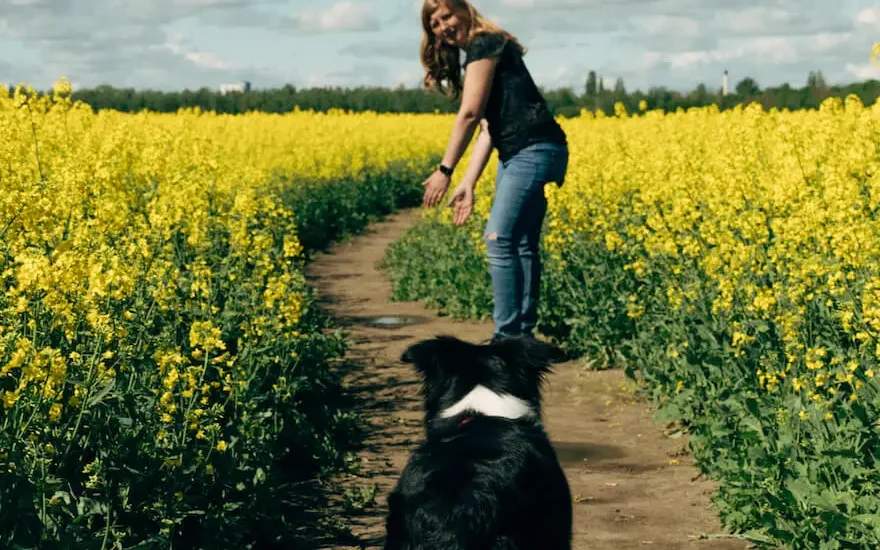
Do not run after your dog. You can practically never catch up with him. If a familiar person runs after him in a panic, he tends to get even more scared and runs farther away. This applies to every dog, not just fearful ones.
Stay at the spot where he got away. After some time, dogs often come back to exactly the place where they ran off. FINDEFIX advises waiting there as long as possible, if need be for several hours. Use the waiting time on your phone: report your dog as missing right now to TASSO, FINDEFIX and the local police station (how is explained further below), call family and friends, and ask passersby.
Have someone check at home and at the car. Some dogs follow their usual walking route home, others go back to the parked car. Ask a second person to wait at home. If you came by car, have someone check there too.
Make a quick note: When and where did you last see him? What was the weather like? Why did he take off: a scare, fear, an accident, prey drive, play at the dog park? The reason decides what helps now. If an accident was involved or he ran off wearing a leash, every hour counts (see search dogs below).
Emergency on the road: If your dog runs onto a highway or a busy road, that is an acute danger for everyone. Then you dial 110 right away and never run onto the road yourself.
The First Hours: Searching Nearby
Search in a star pattern. Walk from the spot where he got away in one direction, come back, then take the next direction. This creates a straight scent trail that leads your dog back to the starting point. Avoid highways and railway tracks so your dog does not follow your trail to dangerous places.
Leave scent and food behind. If you have to leave the spot where he got away, leave a worn piece of clothing there. TASSO especially recommends socks because they smell strongly of you. Add food and, in warm weather, water. If your dog comes back, he smells you and is more likely to stay close.
Set up a feeding spot at home. If your dog ran away from home, TASSO advises leaving the garden gate and front door open, even at night. Many lost dogs start their way back under cover of darkness. Of course that only works if no other animals can slip out. Put a worn piece of clothing there too.
Check hidden places. A frightened or injured dog can be very close. On your own property, look in the garage, cellar, garden shed, shafts and pool, and ask your neighbors to check on their property. Injured dogs often crawl under bushes. If your dog ran off wearing a collar and leash, he may have gotten caught somewhere.
Call out or not? With a friendly, outgoing dog you may call his name during the search and use familiar sounds, such as shaking the treat tin. If your dog is fearful or ran off in a panic, do not call him: loud voices drive him farther away.
No search parties of strangers. The more strangers actively search, the more hunted your dog feels and the farther he runs. A frightened dog that is cornered can also bite.
If Your Dog Is Fearful
Searching works differently for fearful dogs, for example those fresh from animal rescue:
- Tell everyone explicitly that it is a fearful dog and that nobody should catch him. Also inform the organization that placed him, and leave your number.
- Stay at the spot where he got away as long as possible and do not call him.
- Set up a feeding spot at the spot where he got away and at home. A wildlife camera shows you whether he comes. You need a permit for it.
- Some animal welfare groups lend out live traps against a deposit. For these too you need a permit (the hunting law of your federal state applies) and an instruction beforehand is mandatory, because a dog can otherwise be injured in a life-threatening way.
- Bring in a local volunteer dog-recovery team early (in German a "Tiersicherung"). These are experienced helpers who secure lost dogs. Ask the shelter or animal welfare group about it.
When a Search Dog Helps
Pet trailers are teams with specially trained animal search dogs that follow your dog's trail.
- Call right away if your dog ran off wearing a leash, is a puppy, is old, sick, or might be injured after an accident.
- With other dogs, FINDEFIX advises a search dog if, for example, your dog has not been seen for three days. A reputable pet trailer advises you on when a deployment makes sense.
- Fearful dog without a leash: TASSO advises not using a search dog in the first days, because the search can push him farther away.
Pack something now that smells like your dog, for example a collar, harness, blanket, brush or toy. Put it in a sealed bag so no foreign scent gets on it. The search dog needs this scent sample.
Reporting: TASSO, FINDEFIX and Checking the Chip
Report your dog as missing to both big pet registries as quickly as you can. Both are free and reachable around the clock.
| Registry | Phone (24 hours) | Ways to report and help |
|---|---|---|
| TASSO | +49 6190 937300 | Report by phone, online or by app, free search poster, search notice on the website, forwarding to volunteer search helpers |
| FINDEFIX (German Animal Welfare Federation) | +49 228 6049635 | Report by phone or online, automatic search poster to print, search notice in the radius search on the website |
Not registered yet? With TASSO you can register your dog in the same form and report him missing right away. FINDEFIX also accepts missing reports if your dog is registered with another registry. So report him to both.
Check the chip registration. A microchip alone will not bring your dog home. It only carries a number. Shelters and vets can only find you if that number is registered with a registry together with your contact details. Check now whether your dog is registered and whether your phone number and address are correct. With TASSO you can also allow your details to be passed on to the finder. Then finders can call you directly.
Who You Call
Finders hand dogs in at very different places. These places are not connected with each other, so you have to inform each one yourself and leave a phone number you can be reached at everywhere:
- Shelters and animal welfare groups within up to 50 kilometers
- Police: the number of your local station, so the emergency line stays free. At night the police are often the first point of contact for finders. Dial 110 only in an emergency on the road (see above).
- Public order office and lost property office: Anyone who finds a dog has to report it there.
- Vets and animal clinics: Injured dogs usually end up there first. You can email them the search poster.
- Foresters and hunting leaseholders, especially in rural areas
- Municipal works depots, road and highway maintenance departments: Their staff recover animals after accidents. The call is hard, but it gives you certainty.
- Your dog school or dog boarding facility and dog owners from your usual walking route
- Your dog liability insurance: A dog running loose can cause an accident. Some insurers want to know.
Check back regularly at all of these places over the next days to ask whether your dog has been handed in.
Search Posters and Local Groups
Anonymous search notices only. TASSO and FINDEFIX create a free search poster for you with their hotline instead of your number. Share exactly this notice on Facebook and other networks too. Scammers deliberately scan search notices for private phone numbers. Do not offer a reward, as that also attracts scammers, and animal lovers help anyway. If you do want to give your own number in addition, use a second number for the search (such as a prepaid SIM) and write "our dog" and "we": scammers are more likely to call individuals than families.
Beware of scams. If someone calls, poses as an animal clinic, shelter or lawyer, and wants money in advance for pickup or treatment, TASSO says that is a scam attempt. Do not pay anything. A real shelter settles boarding costs only at pickup and never asks for money in advance.
Where to hang them? Bus stops, train stations, supermarkets, parking lots, vet practices, shelters and small shops within several kilometers. Have friends or relatives hang the posters in busy places. TASSO advises this so your dog does not follow your scent trail into traffic. In shops, practices and shelters you ask on the spot. For lampposts and other places along the street you ask your town or municipality beforehand, otherwise a fine may follow.
Making the posters last. Laminate them or put them in waterproof sleeves. Attach them with strong tape or staples, but never with nails or thumbtacks on trees, which harms the trees and is prohibited. Note down where they hang, and replace them after two weeks. Posters softened by rain look old, and passersby think the dog has already been found.
Local groups and multipliers. Share the anonymous search notice in local Facebook groups for missing animals, talk to neighbors, and inform the local radio station or daily newspaper. Taxi drivers, mail carriers, joggers and other dog owners see a lot and often help. Tell all helpers: do not catch him, do not run after him, call the number on the poster right away.
Check found notices. People who find a dog often put up notes on lampposts and bulletin boards themselves or post in found-pet groups. Check there and in the "found" ads of the local newspaper regularly.
If You Spot Your Dog
As hard as it is: be quietly happy. Your dog is in a state of emergency and may not react the way he usually does. Loud calling or crying can scare him off again.
- Do not run straight at him, move slowly.
- Crouch down and turn your side or back to him.
- Talk to him quietly and call him calmly, for example with treats.
- If you notice you cannot secure him, stop. If he is seen again and again at the same spot, set up a feeding spot there. With a fearful dog, bring in the volunteer dog-recovery team now.
If others spot your dog, be there yourself for the securing if possible and bring a transport crate. After days outdoors he may not be as friendly as usual.
When He Is Back
- Cancel the report: with TASSO through the "Tier wieder da" form (the "pet is back" form), with FINDEFIX as returned, and at every place you called.
- Clean up: Delete your posts on social networks, take down the posters, and pick up clothing and bowls at the spot where he got away.
- Health: If you have other animals, first bring the returnee into a separate room, as foreign smells can trigger fights. He may have brought back fleas or worms. If in doubt, see the vet.
Then it is worth taking an honest look at your notes from day one: why did he run off?
Prevention: So It Does Not Happen Again
Chip and register. Have your vet chip your dog and register him for free with TASSO and FINDEFIX. After every move and every change of phone number, check that your contact details are still correct.
Train recall. A reliable recall lowers the risk in everyday life when the leash snaps or a deer jumps up. But in a real scare even a well-trained dog can bolt, so recall replaces neither a secure leash nor registration. If your dog hardly listens outdoors, training starts on a long line. Why he sometimes does not come is explained under dog does not listen, and with strong prey drive anti-hunting training helps.
Secure on the leash. A dog can quickly wriggle out of a loose collar or dog harness when startled. For fearful dogs there are safety harnesses with an extra belly strap that make this much harder. How your dog walks relaxed next to you is covered in how to leash train a dog.
GPS tracker. The chip cannot locate your dog. A GPS tracker on a well-fitting harness shows you his location as long as battery and reception last. With TASSO you can link a tracker to the app and share the location with search helpers nearby in an emergency.
Take New Year's Eve seriously. Many dogs bolt out of fear of a bang. Around New Year's Eve, even a dog with good recall goes out only on a leash and in a safety harness. More on that in New Year's Eve with a dog.
Related Topics
Did you pay attention?
Question 1 of 3Your dog ran off on a walk. What do you do first?
It is best to practice recall and loose-leash walking before anything happens. In the Hundeo courses "Perfect Recall" (6 lessons) and "Master Loose-Leash Walking" (9 lessons) you build up both step by step. With Hundeo Pro you get all lessons as video guides, plus training tracking and personal help from real trainers when you run into problems.
Sources
- Search tips for lost dogs (TASSO)
- Search tips for lost dogs and cats, protection from scams (TASSO)
- Cat or dog missing? Here is what you can do (TASSO)
- Dog missing! What to do? (FINDEFIX)
- Guide: how to find your pet again (FINDEFIX)
- Create a missing report and search poster (FINDEFIX)
- Missing pet: checklist (German Animal Welfare Federation)