
Seven commands are enough for a relaxed life with your dog. Sit, Down, Stay, Come, Heel, Drop It and No form the foundation on which all further training builds. The order is no coincidence: each command requires the previous one.
- 7 basic commands: Sit, Down, Stay, Come, Heel, Drop It, No
- Follow the order: each command builds on the previous one
- Training from 8 weeks in short sessions (3-5 minutes, puppies shorter: 2-3 minutes)
- Always introduce hand signal and word at the same time
- 9-out-of-10 rule: only advance when 9 out of 10 attempts work
- One command per week is a good pace
Overview: The 7 Basic Commands
| Command | Hand Signal | Prerequisite | From When | Difficulty |
|---|---|---|---|---|
| Sit | Index finger up | None | 8 weeks | ⭐ |
| Down | Flat palm downward | Sit | 8 weeks | ⭐ |
| Stay | Flat palm in front of dog | Sit or Down | 10 weeks | ⭐⭐ |
| Come (recall) | Arms spread wide | Knows name | 8 weeks | ⭐⭐⭐ |
| Heel | Pat on thigh | Sit + eye contact | 10 weeks | ⭐⭐ |
| Drop It | Open palm | None | 8 weeks | ⭐⭐ |
| No | Short head shake | None | 8 weeks | ⭐ |
The Order
Why does the order matter? Down only works from a Sit position. Stay requires the dog to already be in a stable position. Heel needs eye contact, and you teach eye contact as a side effect during Sit training.
Start with Sit. Most dogs learn it in 1-3 days because it uses a natural movement: head up, rear down. Then Down. Then Stay. Come and Heel come in parallel once the foundation is in place. Drop It and No are trained in everyday life as situations arise.
1. Sit

The simplest command and the basis for everything that follows. Guide a treat backwards over the head. The dog lifts its head and sits automatically. Mark and reward immediately. Don't push the rear end down.
Hand signal: Index finger pointing up. Introduce word and gesture at the same time, once the movement works without a lure.
Common mistake: Introducing the word too early. Only add the word "Sit" once the movement works 9 out of 10 times without a verbal cue.
Detailed guide: How to Teach Your Dog to Sit in 4 Steps
2. Down
From the Sit position: guide a treat straight down to the ground, directly between the front paws. Don't pull it horizontally. The dog lowers its head and shoulders and lies down. Reward immediately.
Hand signal: Flat palm, facing downward, toward the ground.
Help with problems: If the dog won't go down, use the leg bridge: raise one leg as a tunnel and guide the treat underneath. The space is too tight to stand, so the dog has to crouch.
Detailed guide: Teach Your Dog to Lie Down in 4 Steps
3. Stay
Stay holds the dog in Sit or Down until you release it. Three dimensions to increase separately: duration, distance and distraction. Never raise two at the same time.
Hand signal: Flat palm like a stop sign in front of the dog.
Start with 1 second. Reward while the dog is still in position, not afterwards. Then 2 seconds, 5, 10, 30. Only once the duration is solid, take one step back. Always return to the dog and reward there; don't call it to you.
Release signal: "OK" or "Free". Without a release signal, the dog decides on its own when to get up.
Detailed guide: Teach Your Dog Stay in 4 Steps
4. Come (Recall)
The most important safety command. A reliable recall can save lives in traffic. "Come" must always pay off for the dog, without exception.
Hand signal: Arms spread wide (inviting gesture).
Start at home: say the name, call "Come", give a jackpot reward (the very best treat you have). Never call "Come" to leash the dog, bring it to the car, or do something unpleasant. Every recall must end positively.
Outdoors, practise first on a long line. That way you can guarantee success without letting the dog run free. Only try without a leash once the recall works 9 out of 10 times on the long line.
Common mistake: "Come! COME! COME HERE!" Calling repeatedly teaches the dog it doesn't have to respond the first time. Call once, wait. If it doesn't come, go to the dog and reduce the difficulty next time.
5. Heel
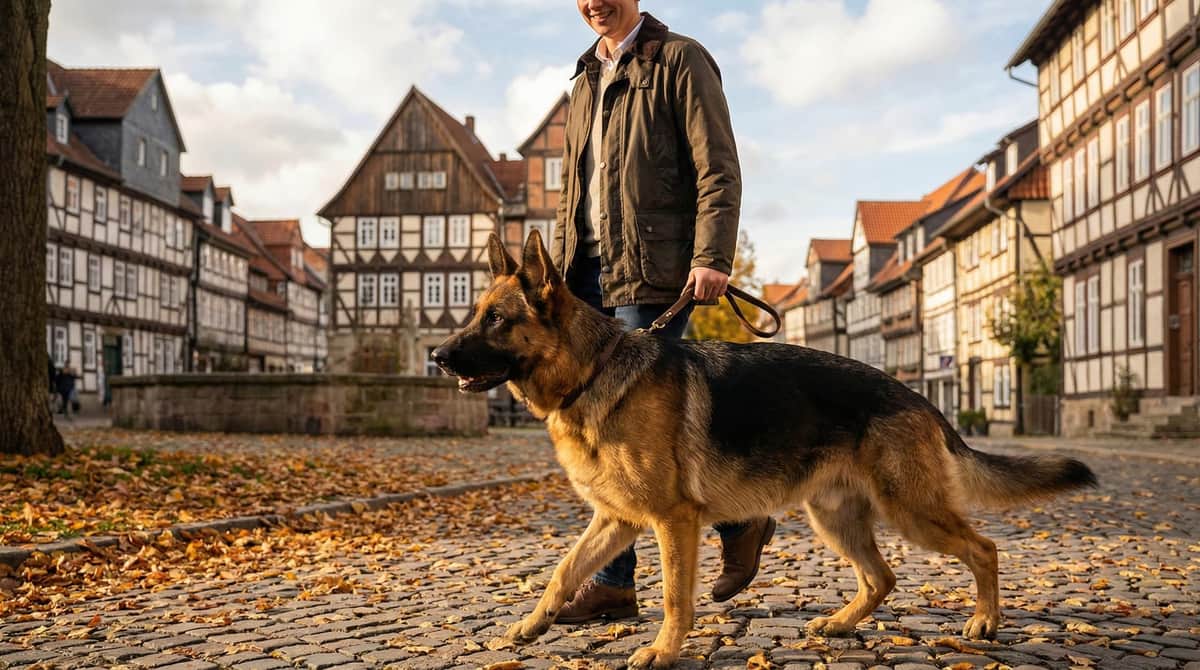
Your dog walks at knee height beside you, attentive and without pulling. Heel is not a permanent state. 30 seconds on the road or 1 minute through a crowd is enough. In between, the dog can sniff on a loose leash.
Hand signal: Pat on the thigh on the side where the dog should walk. Left is standard.
Prerequisite: eye contact must work. Without eye contact, no Heel. Hold a treat in your left hand at knee height. Say "Heel", walk 2-3 steps, reward. Gradually increase the distance.
Detailed guide: Teach Your Dog to Heel in 4 Steps
6. Drop It
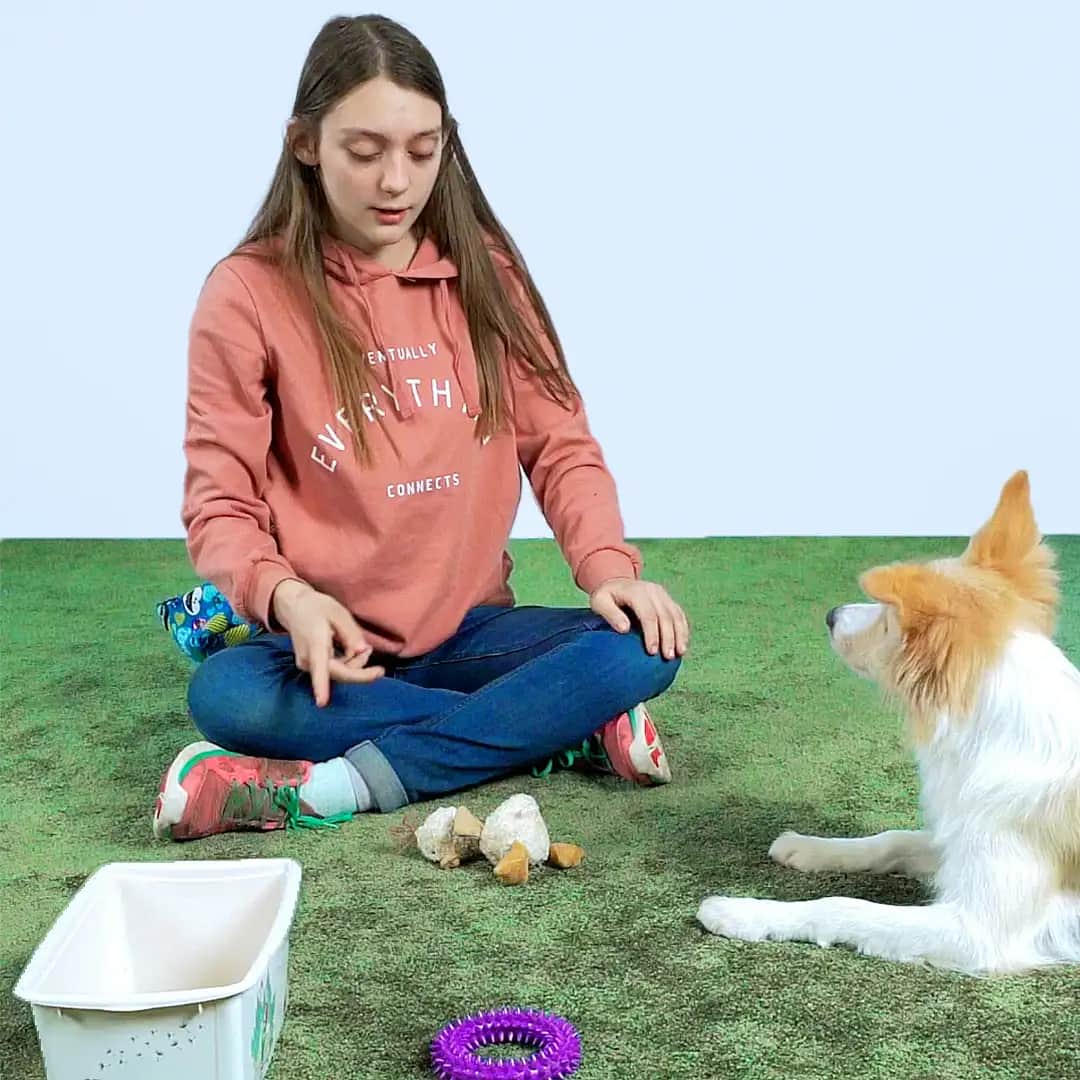
Drop It means: let go of whatever is in the mouth. Whether it's a toy, a sock, or something from the ground. The principle is trading, not taking.
Hand signal: Show an open palm in front of the dog.
Practise with a toy: the dog holds a toy, you show a treat. As soon as it lets go, say "Drop It", give the treat, return the toy. The dog learns: letting go pays double. Never snatch things from the mouth; that creates guarding and resistance.
For anti-poison bait training, Drop It is a basic prerequisite.
7. No
No is an interruption signal. It stops whatever the dog is doing. Not to be confused with Drop It (letting go). No means: stop doing that.
Hand signal: Short head shake or raised index finger.
Say it calmly and firmly, don't shout. Immediately offer the alternative and reward it. The dog sniffs at the table? Say "No", send it to its spot, reward there. The dog learns: moving away from the table brings something better than what's on it.
Use sparingly. If you constantly say "No", the signal loses its value. Better to set up the environment so fewer No-situations arise. Move the bin away instead of saying "No" 20 times a day.
Your Command Progress
0/7Hand Signals and Why They Matter
Dogs process visual signals faster than auditory ones. A study from the University of Naples showed that when signals conflict (word says "Sit", gesture shows "Down"), dogs follow the gesture, not the word.
Practical advantage: many dogs become hard of hearing with age. If you train hand signals from the start, you can still communicate reliably with your dog later. Always give word and gesture at the same time until the dog links both securely.
Training Rules for All Commands
Short sessions. 3-5 minutes per session, 3-4 times a day. Puppies shorter, about 2-3 minutes. Stop when things are going well, not when the dog is frustrated.
The 9-out-of-10 rule. Only move to the next level when 9 out of 10 attempts work. If you advance too early, you won't build stable behaviour.
Marker word or clicker. The marker bridges the gap between correct behaviour and treat. It must come in the second the dog gets it right. More on this: Clicker Training
One word, said once. "Sit. Sit! SIT!" teaches the dog it doesn't have to respond the first time. Say it once, wait. If there's no response, go back one step.
End on a positive note. Finish every session with something easy that the dog already knows. That keeps motivation high for the next session.
Common Mistakes
Ignoring the order. Training Heel before Sit is solid doesn't work. Each command builds on the previous one.
Sessions too long. After 10 minutes, focus drops. Three short sessions produce better results than one long one.
Rewarding at the wrong moment. The reward must come while the dog is still in the correct position, not after it stands up. Have treats ready beforehand.
Different words for the same command. "Sit", "Sit down", "Take a seat" is confusing. One word per command, and all family members use the same one.
Only training indoors. Every command must be rebuilt under distraction. The dog hasn't forgotten; it just can't perform it outside yet.
Once the basic commands are solid, things get creative: in our dog tricks overview you'll find 25 tricks that build on these commands. From Paw to pulling off socks.
Did you pay attention?
Question 1 of 3In what order do you train the basic commands?
The exercises in this article are an excerpt from the Hundeo course "Basic Commands". With Hundeo Pro you get all verbal cues as video tutorials in four difficulty levels, plus training tracking and personal help from real trainers when you need it.